Wide Angle Phone Lens: 2026 Guide to Pro Mobile Shots
Your phone’s built-in ultra-wide mode is actually holding your content back. You’ve likely noticed that while it captures more of the scene, the edges often look like a distorted funhouse mirror. The quality usually drops the second the sun goes down, leaving you with grainy, unusable files. It’s frustrating when you’re trying to capture a sweeping landscape or a high-end real estate interior, only to end up with a result that looks amateur. You deserve better than software-stretched pixels.
We believe that professional results should be accessible to every creator. Finding the right wide angle lens for phone photography is the secret to unlocking crisp, edge-to-edge clarity. In this 2026 guide, you’ll discover how a high-quality 16mm lens transforms your mobile device into a serious creative powerhouse. We’ll show you how to achieve zero-distortion shots, maintain your optics with specialized cleaning spray, and build a lightweight setup perfect for the Israeli market. Get ready to elevate your visual storytelling and start shooting like a pro.
Key Takeaways
- Stop compromising on image quality and learn how external optics leverage your smartphone’s primary sensor for professional clarity.
- Discover why a premium wide angle lens for phone setups outperforms native ultra-wide modes by eliminating grainy low-light noise and edge distortion.
- Master the “Sensor Secret” to capture high-resolution landscapes and real estate shots that look like they were taken on a DSLR.
- Learn the essential steps for maintaining your gear with specialized Lens Cleaning Spray to ensure every frame is crystal clear.
- Explore how to build a lightweight, cinematic creator kit using 16mm optics and magnetic filter mounts for ultimate creative control.
What is a Wide Angle Lens for Phone and Why Do You Need One?
A wide angle lens for phone is your ticket to a bigger world. It’s a precision-engineered optical tool designed to pull back the curtain on your environment. Most standard smartphone cameras sit around a 24mm or 26mm focal length. This works for basic portraits, but it fails when you’re faced with a massive skyscraper or a crowded dinner table. You’ve felt the frustration of backing into a wall just to fit everyone in the frame. A dedicated lens solves this by physically expanding what your sensor can see without forcing you to move an inch.
It isn’t just about fitting more objects into a single shot. It’s about how the final image feels. Wide-angle photography creates an immersive experience that standard lenses can’t replicate. It pulls the viewer into the landscape. You aren’t just looking at a photo of the Negev desert; you’re standing in it. This is true optical expansion. Unlike digital zooming or software tricks that stretch and distort your image, a physical wide angle lens for phone preserves every pixel of detail. It respects the original data while giving you a grander perspective.
Breaking Down the Field of View (FOV)
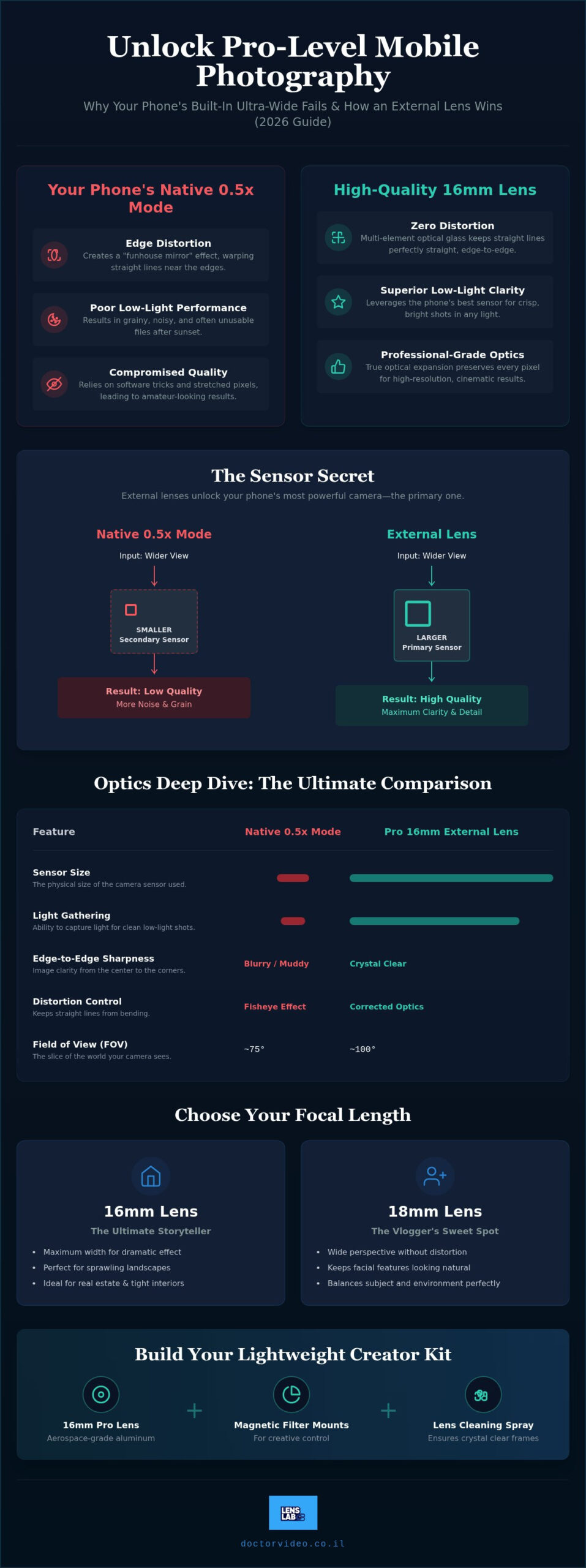
Think of FOV as the slice of the world your camera sees. While your native lens might capture a narrow 75-degree slice, a high-quality 16mm lens opens that up to a massive 100-degree view. This is a game-changer for real estate creators. Small rooms that look cramped on a standard lens suddenly feel spacious and premium. In the vast landscapes of Israel, that extra visibility is the difference between a basic snapshot and a cinematic masterpiece. It makes the environment feel breathable and expansive.
The Creator Advantage: Why Software Isn’t Enough
Many creators assume their phone’s built-in 0.5x mode is enough. It isn’t. Native ultra-wide modes often rely on smaller sensors that struggle the moment the light fades. This is why smartphone camera add-on lenses are making a massive comeback among serious vloggers and influencers. They act as the bridge between mobile convenience and professional cinematography. At LensLab, we believe professional results are about having the right glass. By using a dedicated lens, you use your device’s primary sensor to its full potential. It’s about working smarter to achieve that high-end look without the heavy gear.
The Science of Quality: Optical Glass vs. Native Ultra-Wide
Your phone’s primary camera is a high-resolution beast. It features the largest sensor and the best low-light performance on your device. Most built-in ultra-wide modes use a much smaller, secondary sensor. This is the “Sensor Secret.” When you switch to the native 0.5x mode, you’re often sacrificing image quality for a wider view. By mounting a professional wide angle lens for phone over your primary camera, you keep that superior sensor performance while gaining the expansive field of view you need. It’s the most efficient way to get pro-level shots without upgrading your entire phone.
Light gathering is the biggest differentiator. A larger sensor captures more light. This is essential for crisp shots during a sunset in the Galilee or inside a sleek Tel Aviv showroom. High-quality glass prevents the “fisheye” effect that plagues cheap alternatives. It also stops “purple fringing,” those annoying discolored lines that appear on high-contrast edges like tree branches or building corners. You get edge-to-edge sharpness instead of the blurry, muddy corners common in native phone modes. Your images stay clean, sharp, and ready for high-end production.
Multi-Element Lens Design Explained
Pro lenses aren’t made from a single piece of glass. They use a complex 5-element or 6-element design to manage light perfectly. These layers ensure that light hits your sensor accurately, preventing blur. Optical distortion is the unwanted curving of straight lines. Multi-element glass corrects this, keeping architectural lines straight and true. These lenses are typically built with aerospace-grade aluminum. This housing protects the delicate optics from the intense heat and dust of the Israeli climate. It’s gear designed to last through every shoot.
16Mm vs. 18mm: Choosing Your Focal Length
The 16mm lens is the ultimate tool for dramatic storytelling. It provides the maximum width possible. This makes it the go-to choice for sprawling desert landscapes or tight real estate photography where every centimeter of space matters. If you’re a vlogger, the 18mm focal length is often the sweet spot. It offers a wide perspective without making your facial features look unnatural. It strikes a balance between showing your environment and keeping the focus on you. Focal length also changes how much of the background feels “compressed” against your subject. A wider lens makes the world feel vast and deep. If you want to see how these optics change your workflow, explore the professional gear at doctorvideo.co.il to find your perfect match.
External Lens vs. Native 0.5x Mode: The Ultimate Comparison
Stop settling for the mushy, low-resolution results of your phone’s built-in ultra-wide mode. While manufacturers market the 0.5x button as a professional feature, the hardware often tells a different story. Most secondary sensors are significantly smaller than the primary one. This results in smaller pixels that struggle to capture enough light for a clean image. When you use a high-quality wide angle lens for phone over your main camera, you’re leveraging the best hardware your device offers. You keep the wide f/1.8 or f/1.5 aperture of your primary lens. Native ultra-wide modes usually drop to f/2.2 or f/2.4. This difference is massive. It’s the reason your native wide shots look grainy the moment you step indoors or the sun begins to set.
Native modes also rely heavily on software correction to fix image warping. Your phone’s processor has to unwarp the image digitally in real-time. This process leads to a noticeable loss of sharpness at the edges and an artificial, plastic look. Serious filmmakers and real estate photographers using smartphone lenses in Israel avoid this at all costs. They want the raw, unadulterated power of the primary sensor. An external lens provides a purely optical solution. It bends the light before it ever hits the sensor. This ensures your architectural lines stay straight and your textures stay rich and natural.
Resolution and Low-Light Performance
Your primary sensor captures significantly more data than the secondary ones. This is crucial for anyone shooting in 4K or 8K. When you record video, you need every bit of dynamic range possible to preserve details in the highlights and shadows. Native ultra-wide sensors often crush the shadows, leaving you with black blobs instead of usable detail. Night shots on these sensors look mushy because the noise reduction software is working overtime to hide sensor limitations. By using an external wide angle lens for phone on the main sensor, you maintain professional clarity even in challenging lighting. You get more flexibility in post-production. Your colors remain vibrant. Your content looks like it was shot on a cinema camera rather than a standard mobile device.
The ‘Fisheye’ Trap and How to Avoid It
Don’t confuse a professional wide-angle lens with a cheap fisheye. A true wide-angle, like a 16mm, is designed to be rectilinear. This means it’s engineered to keep straight lines straight. A fisheye lens purposefully distorts the image into a 180-degree curve. For professional architecture or travel vlogging, you want the 16mm’s natural, expansive look. To get the best results, alignment is everything. Ensure your clip-on lens is perfectly centered over your phone’s camera. If it’s slightly off, you’ll see vignetting, which are those dark, blurry corners. Take a second to check your screen before you hit record. It’s a small step that makes a professional difference in every frame.
Pro Techniques: Mastering Your Wide Angle Lens for Phone
Great shots start with crystal-clear optics. Before you attach your wide angle lens for phone, use a pro cleaning kit to remove every smudge from your native camera and the add-on glass. Even a microscopic fingerprint will catch the light and create a hazy, amateur flare. Once your gear is prepped, activate the gridlines on your screen. Use the ‘Rule of Thirds’ to anchor your composition. Place your main subject or the horizon along these lines to create instant balance. For video, always lock your focus and exposure. Long-press on your subject until the ‘AE/AF Lock’ appears. This prevents the camera from ‘hunting’ for light as you move through different environments.
Depth is the secret to a professional wide-angle shot. Don’t just stand back and shoot from a distance. Get physically close to an object in the foreground. Wide lenses exaggerate the space between objects. By placing a textured rock, a piece of furniture, or a plant near the lens, you create a massive sense of scale. It pulls the viewer into the scene and provides a three-dimensional feel that standard lenses simply can’t match. This technique is especially effective when shooting the diverse textures of the Israeli landscape, from the salty shores of the Dead Sea to the urban architecture of our cities. If you also want to capture intricate close-up details of those textures, pairing your wide-angle setup with the best macro lens for smartphone photography gives you a complete creative toolkit.
Smartphone Lens for Landscape Photography
Landscape creators must master the art of leading lines. Use a path, a shoreline, or a fence to guide the viewer’s eye toward the horizon. A wide angle lens for phone is essential for capturing the true scale of the mountains in the North or the vastness of the Negev. It allows you to fit the drama of the sky and the detail of the ground in one frame without losing quality. For advanced lighting tips and gear recommendations, refer to our 2026 Landscape Guide to master your outdoor shoots.
Real Estate and Interior Photography Secrets
Precision is everything in real estate. Use the ‘Corner Technique’ by shooting from the far corner of a room to make small spaces look spacious and inviting. It’s vital to keep your phone perfectly level. If you tilt the device up or down, your vertical lines will distort, making buildings and walls look like they’re leaning. This is a common mistake that ruins professional listings. A high-quality 16mm lens captures the natural flow between two rooms in a single shot. This gives potential buyers a clear understanding of the floor plan. It turns a simple photo into a professional walkthrough experience. For a complete breakdown of tools and techniques, our smartphone lens for real estate photography guide covers everything you need to elevate your property listings.
Ready to transform your mobile content with professional-grade optics? Explore the 16mm Wide Angle Lens and start shooting like a pro today.
Building Your Creator Kit with LensLab Essentials
Your journey to professional mobile cinematography starts with a shift in mindset. You don’t need a heavy backpack full of expensive DSLR gear to capture world-class visuals. The modern “Travel Light” philosophy is about maximizing your smartphone’s potential with a few high-impact tools. A premium wide angle lens for phone is the foundation of this setup. It allows you to tell expansive stories without the bulk. By choosing a streamlined kit, you stay agile and ready to shoot the moment inspiration strikes. This efficiency is the hallmark of the modern creator.
The 16mm Wide Angle Lens for Smartphones is your primary creative engine. It delivers the professional field of view required for high-end travel and real estate content. To take your lighting to the next level, the JJC Magnetic Lens Filter Mount Adapter for iPhone is a total game-changer. It allows you to snap on ND or CPL filters in seconds. You get instant control over reflections and exposure without fumbling with screw-on threads. This speed is essential when you’re chasing the perfect light during a busy shoot. It turns your phone into a versatile production tool that adapts to any environment.
Maintenance is the final pillar of a pro creator kit. Dust and smudges are the enemies of sharp optics. Keep your glass pristine with a specialized Lens Cleaning Spray. A single spray and a quick wipe ensure your 16mm optics perform at their peak every time. This level of care separates the hobbyists from the serious creators who value their output. When your gear is clean, your images stay crisp and your post-production workflow stays simple. It’s a small habit that yields massive results.
The Perfect iPhone Photography Kit for Travel
Travel photography is about being prepared for anything. Pair your wide-angle lens with our comprehensive iPhone travel checklist to ensure you never miss a shot. The 16mm lens is often the only glass you need for tight city streets or sweeping mountain hikes. It’s compact, lightweight, and fits into your pocket. Organize your kit so your lens and cleaning spray are always within reach. Speed is your biggest advantage in the field. You’ll spend less time digging through a bag and more time capturing the perfect frame.
Ready to Level Up? Join the LensLab Community
At LensLab, we are more than just a gear provider. We are your creative partner. We offer 24/7 support to help you master your wide angle lens for phone and solve any technical hurdles. We know that timing is everything for creators. That’s why we prioritize fast delivery across Israel to get your gear to you before your next project begins. Professional results are no longer reserved for those with years of technical training. With the right tools and a can-do spirit, you are ready to produce cinematic content today. Join a global community of creators who are pushing the boundaries of what a smartphone can do.
Elevate Every Frame with Professional Optics
Your smartphone is no longer just a communication device. It’s a professional-grade cinema camera waiting for the right tools. You now understand that superior optical glass outperforms native software every time. By leveraging your phone’s primary sensor, you can capture high-resolution landscapes and expansive real estate shots without the grainy distortion of standard ultra-wide modes. It’s time to stop settling for amateur results and start crafting visuals that demand attention.
Investing in a high-quality wide angle lens for phone is the fastest way to bridge the gap between hobbyist and pro. Our high-clarity multi-element glass ensures edge-to-edge sharpness for every project. Trusted by professional vloggers globally, our gear is designed for those who refuse to compromise on quality. With fast worldwide shipping and 24/7 support, you can upgrade your creator kit and start shooting immediately.
Elevate your content with the LensLab 16mm Wide Angle Lens and transform your perspective today. You’ve got the vision. Now, you’ve got the glass. Go out and create something extraordinary.
Frequently Asked Questions
Will a wide angle lens work on my dual or triple-camera phone?
Yes, a high-quality lens works perfectly on multi-camera devices by mounting directly over the primary camera. You should identify your main sensor, which usually has the best low-light performance. Once attached, your phone treats the add-on as part of the native optics. This setup allows you to use your device’s most powerful sensor for wide-angle shots instead of switching to the lower-quality secondary lenses.
Does a wide angle lens for phone reduce image quality?
A premium wide angle lens for phone actually improves your results by leveraging your primary sensor’s superior data. Cheap plastic lenses cause blur, but professional multi-element glass maintains edge-to-edge sharpness. You avoid the digital noise and grain typically found in native ultra-wide modes. It’s about using better glass to capture more light and detail while keeping your resolution high for professional editing.
What is the difference between a 0.45x and a 0.6x wide angle lens?
The numbers represent the magnification factor, where a lower number like 0.45x provides a much wider field of view. A 0.45x lens is ideal for dramatic architecture or tight interiors common in Israeli real estate. A 0.6x lens, like a 16mm or 18mm focal length, offers a more natural perspective. It’s the preferred choice for vlogging because it captures the environment without distorting your facial features.
Can I use a wide angle lens for vlogging and selfies?
Yes, wide-angle lenses are essential for solo creators who need to fit themselves and their surroundings into the frame. When you vlog with a standard lens, your face often fills the entire screen. Adding a 16mm lens provides breathing room and a cinematic background. It makes your content look more professional and engaging for your audience. Just ensure the lens is securely clipped for stable movement during your shoot.
Do I need to remove my phone case to use an add-on lens?
Removing your case is highly recommended to ensure the lens sits flush against your phone’s camera. Any gap between the add-on glass and your native lens can cause blur, light leaks, or vignetting. Some specialized creator cases are designed with built-in mounts, but for standard protective covers, a direct connection is best. This simple step guarantees the sharpest possible focus and the most reliable optical alignment for every shot.
How do I fix the black borders (vignetting) when using a clip-on lens?
Vignetting is usually caused by a slight misalignment between the add-on lens and your phone’s camera sensor. To fix this, slowly adjust the clip while looking at your screen until the black corners disappear. If your phone has a very wide primary lens, a tiny 1.1x digital zoom can also eliminate the borders without sacrificing quality. Always double-check your alignment before you start recording to save time in post-production.
Is a 16mm lens better than the native iPhone ultra-wide mode?
A 16mm wide angle lens for phone is superior because it uses the iPhone’s massive primary sensor rather than the smaller ultra-wide sensor. The primary sensor captures more light and offers a wider aperture, which is vital for the diverse lighting conditions in Israel. You’ll notice significantly less grain in the shadows and much sharper details in the corners. It’s the professional choice for creators who prioritize image integrity over software-corrected results.