Smartphone Lenses for Real Estate: 2026 Pro Guide
The most profitable camera for your next listing isn’t a heavy DSLR. It’s the smartphone in your pocket. Modern mobile sensors now rival professional gear from just a few years ago. However, software alone can’t solve every architectural challenge. If you’ve struggled with cramped rooms or curved walls, you know standard glass has limits. This is where a high-quality smartphone lens for real estate photography changes everything for your brand.
We know first impressions are everything in a fast-moving market. You need photos that show off spacious interiors and crisp details. You want to avoid blown-out windows and distorted lines that make a property look unprofessional. This guide shows you how to capture high-end property photos using only your phone and the right optics. We’ll explore essential tools like the 16mm wide-angle lens and magnetic mounting systems for rapid setups. It’s time to turn your smartphone into a professional production studio and speed up your listing turnaround times.
Key Takeaways
- Stop relying on your phone’s built-in ultra-wide lens. Use a dedicated smartphone lens for real estate photography to leverage your device’s superior primary sensor for cleaner, sharper images.
- Capture the full scale of any room without the “fisheye” effect. The 16mm Wide Angle Lens creates natural, spacious-looking interiors that attract more buyers.
- Master high-contrast lighting and bright exterior shots effortlessly. Use ND filters to manage exposure and keep window views clear and colors vibrant.
- Speed up your professional workflow with the JJC Magnetic Lens Filter Mount. This system allows for rapid gear changes so you can move through a property in record time.
- Prioritize image clarity by starting every shoot with a dedicated Lens Cleaning Spray. Eliminating smudges ensures professional-grade results every time you tap the shutter.
The Real Estate Reality: Why Standard Phone Cameras Fail
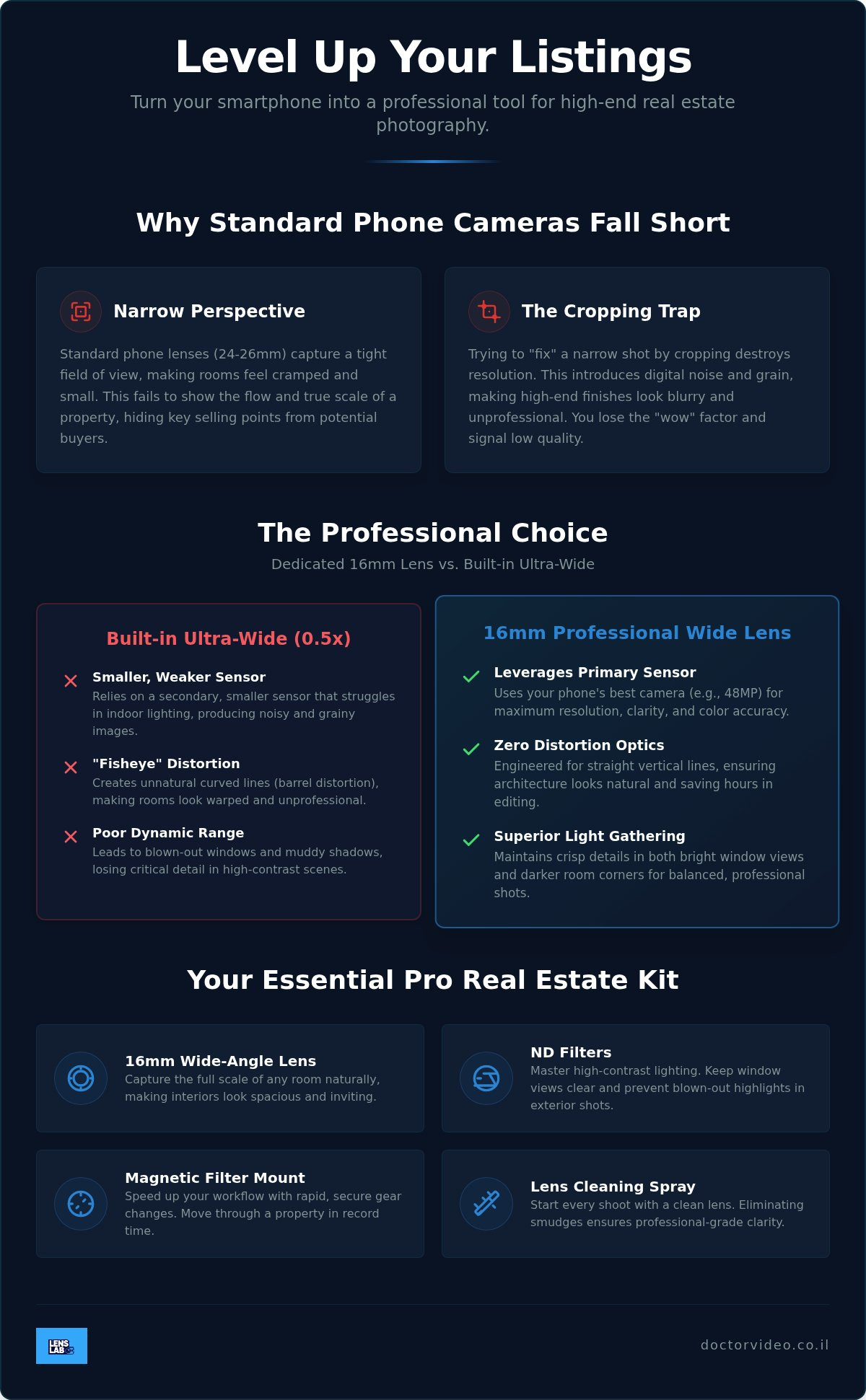
Your smartphone is a marvel of modern engineering. It packs a 48MP sensor and advanced AI processing into a pocket-sized device. But there’s a physical limitation that software can’t fix: the focal length of the standard lens. Most built-in primary lenses sit around 24mm to 26mm. This is great for portraits or street photography. It’s a disaster for property listings. Standard lenses capture a narrow field of view that fails to tell the full story of a home. If you want to compete in a high-stakes market, you need a dedicated smartphone lens for real estate photography.
Your photos are your digital storefront. In 2026, buyers decide to view a home based on a three-second scroll through a listing app. If those photos look amateur, you lose the lead before they even read the description. Professional results require professional optics. You can’t rely on basic hardware to sell a luxury lifestyle.
The Problem with Narrow Perspectives
Ever tried to photograph a half-bath or a compact laundry room? You usually end up with a photo of a sink and half a doorframe. You simply can’t capture the whole room in one shot. This creates a massive psychological hurdle for potential buyers. Cramped photos make a property feel small, dark, and uninviting. When a viewer can’t see the floor-to-ceiling windows or the flow of a room, they move on to the next listing. Narrow shots hide your best selling points. They make spacious layouts look like a series of disconnected closets. Buyers want to see how spaces connect, and standard glass just doesn’t have the reach to show it.
Resolution and the Cropping Trap
Many agents try to fix a bad shot by stepping back or cropping the image later. Stepping back usually means hitting a wall or a kitchen island. Cropping is even more dangerous. When you crop a standard photo to “fake” a better composition, you destroy the resolution. Digital zoom and heavy cropping introduce digital noise and artifacts. These grainy images kill your professional polish instantly. You need edge-to-edge clarity to show off high-end finishes. If a buyer zooms in on a granite countertop and sees digital blur instead of stone texture, you’ve lost the “wow” factor. A smartphone lens for real estate photography allows you to use your phone’s full sensor resolution while capturing the entire space. It’s the difference between a grainy snapshot and a crisp, professional listing photo.
16Mm Wide Angle vs. Built-in Ultra-Wide: The Professional Choice
Many real estate agents assume the 0.5x button on their iPhone or Android is the answer to small rooms. It’s a common mistake. That built-in ultra-wide lens is often a compromise in quality. To stand out, you must use a professional smartphone lens for real estate photography that pairs with your device’s primary sensor. This setup delivers the clarity, depth, and color accuracy that built-in secondary lenses simply can’t match. You aren’t just taking a wider photo. You are taking a better one.
Why Sensor Size Matters for Interiors
Your phone’s primary camera is the star of the show. It features the largest sensor and the most advanced light-gathering technology. Built-in ultra-wide lenses usually rely on much smaller sensors. These smaller sensors struggle in typical indoor lighting conditions. They produce “noise” or graininess that makes a luxury kitchen look cheap and muddy. Staying on your main camera allows you to leverage 48MP resolution and superior dynamic range. When you attach a 16mm Wide Angle Lens for Smartphones to your primary sensor, you get the best of both worlds. You capture a massive field of view while maintaining the professional-grade detail found in high-end DSLR shots. Your shadows stay clean and your highlights remain controlled. This ensures every corner of the room looks crisp and inviting.
Eliminating Optical Distortion
The “fisheye” effect is the enemy of a good listing. When walls appear to curve outward, the room looks unnatural and distorted. This barrel distortion is a hallmark of low-quality built-in lenses and cheap clip-on glass. Professional-grade external optics solve this problem through precision engineering. A 16mm focal length is the gold standard for real estate. It provides a wide perspective that makes rooms look spacious without warping the architecture. Your vertical lines stay vertical. Your doorframes stay straight. This saves you valuable time in the editing phase. You won’t need to fight with perspective correction software to fix curved walls. Using the right glass ensures your photos look honest and high-end the moment you tap the shutter.
Success in this industry is about having the right tools for the job. If you want to transform your mobile workflow, check out the 16mm Wide Angle Lens at LensLab to see the difference for yourself. It is a simple upgrade that delivers massive results for your brand.
Step-by-Step Guide: Capturing Stunning Property Shots with Your Phone
Great gear is only half the battle. You need a repeatable workflow to achieve consistent results. Professional real estate photography isn’t about luck; it’s about following a disciplined technical checklist. These steps ensure your smartphone lens for real estate photography delivers the high-end output your clients expect. Precision at the start saves hours of frustration in post-production.
Preparation and Mounting
Start with a clean slate. Use a dedicated Lens Cleaning Spray before every single shoot. Fingerprint oils create hazy light flares that scream “amateur” and kill contrast. Wipe the glass, mount your gear, and get to work. For those who value efficiency, the JJC Magnetic Lens Filter Mount is a game-changer. It allows for instant, perfectly aligned setup without fumbling with clips. Ensure your external lens is centered directly over the primary camera sensor. Misalignment causes soft edges and dark corners. A precise mount ensures your optics perform at their peak from edge to edge.
Composition Techniques for Real Estate
Composition defines the “feel” of a home. Don’t shoot from eye level. It makes furniture look small and ceilings look oppressive. Lower your phone to chest height instead. This creates a balanced, inviting perspective that mimics how people actually experience a room. Use corners to lead the viewer’s eye through the space. The “three-wall” rule is your best friend. By showing three walls in a single frame, you provide the depth and context buyers crave. It makes the space feel tangible and real. Apply the Rule of Thirds to place key features, like a fireplace or a kitchen island, at the intersection of your grid lines for maximum impact.
Level your horizon every time. Tilted walls make a property feel unstable and unprofessional. Use your phone’s built-in grid or level tool to keep vertical lines perfectly straight. Finally, master your lighting. Tap the brightest part of the room, like a window, and slide the exposure lock down. This prevents the camera from over-brightening the interior and blowing out the view outside. You want your buyers to see the beautiful backyard, not a white rectangle of light. These small adjustments transform a simple smartphone lens for real estate photography into a high-performance listing tool. Follow these steps to build confidence and deliver crisp, spacious photos that get listings sold faster.
Master the Lighting: Using ND Filters for Exterior Real Estate Shots
Lighting makes or breaks a listing. You have already mastered the wide-angle perspective with your 16mm glass. Now it’s time to tackle high-contrast environments. Real estate photography is notoriously difficult because of extreme light variations. Your smartphone lens for real estate photography is powerful, but it cannot defy the laws of physics. High-noon sun creates harsh shadows and blown-out highlights that look amateur. You need a hardware solution to manage the exposure before the light even hits your sensor. Stop fighting the sun. Start controlling it.
Controlling Exposure with ND Filters
Controlling light is about precision. Most phones struggle with the bright midday sun. They automatically overexpose the sky to make the building visible. The result is a washed-out, flat image that lacks professional impact. Neutral Density (ND) filters act as high-quality sunglasses for your camera. They cut down the intensity of the light without shifting the colors. By using a 4-pack ND filter set, you can adapt to any environment instantly. Whether it’s a hazy morning or a brilliant afternoon, you have the tool to keep your skies blue and your architectural details sharp. This professional approach eliminates the need for aggressive post-processing later. You save time and produce more realistic, appealing images that build trust with potential buyers. The 4-pack set gives you options like ND8, ND16, ND32, and ND64. This range ensures you are prepared for any property, any time, regardless of the weather.
Indoor-Outdoor Balance
Buyers want to see the view. If your interior shots feature “white windows,” you are hiding one of the home’s best assets. This happens when the camera tries to expose for the darker room, causing the bright outdoor light to blow out into a white void. Filters help you bridge this gap. You can retain the detail in the garden while keeping the lounge perfectly lit. It creates a seamless transition that feels natural and inviting. This balance is crucial for high-end listings where the connection between indoor and outdoor living is a primary selling point. A clear view of a pool or a landscaped patio through the window adds significant perceived value. Beyond exposure, filters are excellent for reducing unwanted reflections. They cut down glare on polished surfaces like granite islands or marble countertops. This adds a sense of luxury and cleanliness to your photos. You aren’t just taking a picture; you are creating a professional marketing asset.
Ready to master your lighting? Explore the 4-Pack ND Filter Set at LensLab and take full control of your property hero shots today.
Build Your Pro Real Estate Kit with LensLab
Professional real estate photography is no longer reserved for those carrying heavy DSLR kits. Success in 2026 is about maximizing your mobile workflow with superior hardware. You have the skills to compose a shot and manage the light. Now you need a reliable gear kit that keeps up with your pace. A high-quality smartphone lens for real estate photography is the single most important investment you can make for your brand. It transforms a standard device into a high-performance production studio. Don’t let basic hardware limit your creative potential or your listing’s value.
The Essential Gear Checklist
Building a pro kit requires a focus on quality and speed. You need tools that deliver results without adding complexity to your shoot day. Start with these essentials:
- 16mm Wide Angle Lens for Smartphones: This is your foundation. It captures the full scale of a property while maintaining the straight lines buyers expect. It is the essential tool for making small rooms look spacious and inviting.
- JJC Magnetic Lens Filter Mount Adapter: Speed is your greatest asset. Most competitors rely on slow screw-on mounts or bulky clips. This magnetic system allows for instant gear changes. You can snap filters on and off in seconds, ensuring you never miss the perfect light.
- Lens Cleaning Spray: Clarity is non-negotiable. Fingerprints and dust kill image contrast. Keep a dedicated cleaning kit in your pocket to ensure every shot is crystal clear and professional.
- 4-Pack ND Filter Set: Control the sun. Use these filters to balance bright window views and capture vibrant exterior hero shots that stand out on listing apps.
Why Creators Choose LensLab
LensLab positions itself as more than just a gear provider. We are your creative partner in the field. Our optics are engineered specifically for modern, high-resolution smartphone sensors. We know agents are always on the move, so we offer fast worldwide shipping to over 20 countries. You get the gear you need exactly when you need it. If you ever have a technical question or need advice on a specific architectural shot, our 24/7 support team is ready to help. We provide curated bundles that take the guesswork out of mobile production. You get professional-grade results without the steep learning curve of traditional photography. Elevate your brand and speed up your turnaround times with tools designed for the modern creator.
Shop the professional Wide Angle Lens collection now and start capturing stunning property photos today.
Transform Your Listings into Visual Masterpieces
You now have the blueprint to dominate your local market. Professional property photos don’t require a heavy gear bag or years of technical training. By choosing a dedicated smartphone lens for real estate photography, you unlock the full power of your phone’s primary sensor. You have learned that 16mm optics eliminate distortion while ND filters balance harsh window light. These tools ensure every room looks spacious and every view stays crisp. Your listings deserve to stand out in a crowded digital marketplace.
Efficiency is your competitive edge. Our magnetic mounting system allows for 3-second setups; you spend less time fumbling with gear and more time closing deals. Join creators in over 20 countries who trust LensLab for distortion-free, high-impact visuals. It’s time to stop settling for average snapshots and start delivering professional production quality. You have the vision and the drive to succeed. Now you have the right tools to make it happen.
Upgrade your real estate photography with LensLab optics today. You have the vision; we have the glass to bring it to life.
Frequently Asked Questions
Do I really need an external lens if my phone has an ultra-wide mode?
Yes, an external lens is essential for professional results. Built-in ultra-wide lenses often use smaller sensors that struggle in low-light interiors. By using a smartphone lens for real estate photography on your primary camera, you leverage the highest resolution and best light intake. This prevents the graininess and loss of detail common with native ultra-wide modes. You get cleaner images that look much better on high-resolution listing displays and tablets.
Will a 16mm wide-angle lens cause distortion in my room photos?
High-quality 16mm lenses are specifically engineered to keep architectural lines straight. Cheap glass causes a “fisheye” effect where walls look curved. Our pro-grade optics correct this barrel distortion automatically. This ensures that doorframes and ceilings remain perfectly vertical. You save time in post-production because you won’t need to fix warped perspectives. It is the gold standard focal length for capturing spacious rooms without compromising on realism or structural accuracy.
How do I mount a wide-angle lens to an iPhone or Android device?
You can mount your optics using a variety of systems. The most efficient method is the JJC Magnetic Lens Filter Mount Adapter. It provides a secure, perfectly aligned fit for your iPhone or Android. Simply attach the mount over your primary camera and snap the lens into place. If you aren’t using a magnetic system, high-tension clips are a reliable alternative. Always ensure the lens is centered to avoid soft edges or vignetting.
Can I use ND filters with a wide-angle smartphone lens?
Absolutely, and it’s highly recommended for exterior shots. You can stack ND filters onto your wide-angle lens using the JJC Magnetic Lens Filter Mount. This setup allows you to control bright sunlight and prevent blown-out skies in your hero shots. It also helps balance interior lighting with bright views through windows. Using filters in tandem with your smartphone lens for real estate photography creates a balanced look that software can’t replicate.
What is the best height to take real estate photos with a smartphone?
The best height is usually around chest level, roughly 4 to 5 feet off the ground. Shooting from eye level often makes the ceiling feel too close and the furniture look small. Lowering the camera creates a more inviting and balanced perspective. It helps the viewer feel like they are walking through the space. Keep your phone perfectly vertical to avoid tilting walls, which can make a room feel unstable or unprofessional to buyers.
How do I prevent blurry photos when shooting property interiors?
Clarity starts with a clean lens. Use a dedicated Lens Cleaning Spray to remove oils before you start. Since interiors are often dim, use a tripod or a mobile grip to keep the phone steady. This prevents motion blur during longer exposures. You should also tap the screen to lock your focus and exposure on a mid-tone area of the room. This ensures the camera doesn’t hunt for focus in low-light corners or shadows.
Is a 16mm lens better than an 18mm lens for real estate?
A 16mm lens is generally superior for real estate work. Those extra 2mm make a massive difference in tight spaces like bathrooms or small kitchens. An 18mm lens is great for general photography, but it might not be wide enough to capture a “three-wall” perspective in a compact room. The 16mm focal length provides that extra reach needed to make interiors look truly spacious and open without introducing the unnatural distortion found in wider glass.
Do these lenses work with phone cases?
It depends on the thickness of your case. Most magnetic mounting systems and clips work best with thin cases or no case at all. If your case is too bulky, it can prevent the lens from sitting flush against the camera, leading to blurry edges or dark corners. For the best results, use a dedicated lens case or remove your standard case before shooting. This ensures perfect alignment and maximum image quality for every listing.